
Julie here.
Let’s rewind 20 years. I was a new dietitian, settling in my first permanent clinical job at my local children’s hospital. My dream job. I was eager, passionate, and couldn’t wait to get started! I had big ideas. One of them?
Implementing Pediatric Nutrition Screening for All Newly Admitted Patients.
And boy, did I try…
But every attempt hit the same walls:
too much work, too big of a scope, not enough buy-in, not the right timing.
Fast forward to last year, when everything finally came together.
And I can’t wait to tell you how we made it happen.
Why Pediatric Nutrition Screening Matters
I work in Canada, and some of the data that shaped my thinking comes from Canadian research, but the implications apply globally.
A multi-centre study led by Dr. Bélanger and colleague found that:
- 1 in 3 hospitalized children are malnourished on admission
- 40% of children at nutrition risk are never seen by a dietitian during their stay
- Malnutrition is strongly associated with longer hospital stays, slower recovery, and more complications
So, when I was invited to join a Best Practice Spotlight Organization (BPSO) working group focused on pressure injury prevention, led by our exceptional nursing colleagues, I immediately saw an opportunity.
Not just to support pressure injury prevention.
But to consistently screen every child admitted to hospital.
That moment sparked a project that brought together dietitians, nurses, physicians, educators, management, and our IT department, all working toward one shared goal:
Implement pediatric nutrition screening hospital-wide.
Here’s how we did it:
How to Implement Pediatric Nutrition Screening in 7 Steps:
Step 1: Find Your Nutrition Screening Champions
It all began when I joined the BPSO group. Their focus was injury prevention, but you cannot talk about pressure injury prevention without talking about nutrition.
So I made a simple recommendation:
“Could we consider adding a validated nutrition screening tool to our admission process to identify children at risk of malnutrition?”
The group was open, interested, and willing to explore the idea.
That openness was everything.
Step 2: Choose Your Pediatric Nutrition Screening Tool
Before bringing anything forward hospital wide, I gathered a small group of pediatric dietitians from various disciplines.
We reviewed the validated pediatric screening tools available through the Canadian Malnutrition Task Force.
There are two validated pediatric nutrition screening tools currently used in Canada:
- STRONGkids (Screening Tool for Risk On Nutritional Status and Growth)
- PNST (Pediatric Nutrition Screening Tool)
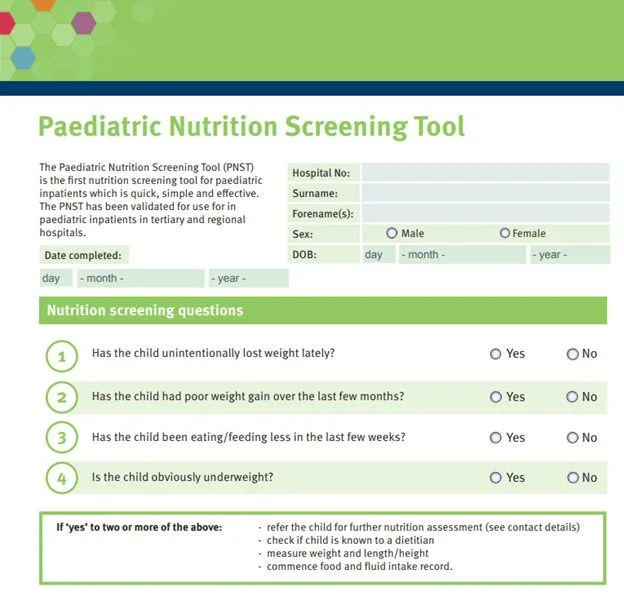
We compared both using our criteria:
✔ validated
✔ quick
✔ nursing-friendly
✔ minimal training required
✔ practical for our diverse inpatient population
Our pick?
The Pediatric Nutrition Screening Tool (PNST)
Simple. Fast. Easy for nurses to adopt. Strong sensitivity.
Step 3: Bring Leadership Along Early
Once our dietitian team aligned around the PNST, we brought it to:
- Professional Practice
- our management team
- and the broader interdisciplinary group
We didn’t frame this as a dietitian project.
We framed it as a:
- patient safety initiative
- quality improvement initiative
- best practice initiative
And because it aligned perfectly with the BPSO’s goals, it felt like a natural fit. And we finally had full management support.
Step 4: Partner With Nursing to Lead the Rollout
This step changed everything.
Nurses are the backbone of any screening process. If the tool is too long, too complicated, or too unclear, it will not be completed consistently.
The BPSO nursing team took the lead in helping us:
- outline clear workflows
- develop education and training
- define what a “positive screen” means
- establish referral pathways to dietitians
This partnership was the catalyst that moved the project from an idea to a true hospital initiative.
Step 5: Build the Tool into the Electronic Medical Record
This is where the project became real.
Working closely with our informatics team, we embedded the PNST directly into the nursing flowsheets, right under their Braden Scale to assess for pressure injury.
If it’s not in the EMR, it doesn’t exist.
And once it was in the EMR — everything changed.
Step 6: Spread the Word (A Lot.)
We picked a go-live date and spent several weeks building awareness and enthusiasm:
- nursing huddles
- unit rounds and bullets
- meeting drop-ins
- emails and reminders
- educator and clinical leader briefings
- physician notifications
- answering every question (sometimes twice)
…and we peppered every unit with an infographic sheet and cue cards.
We wanted the tool to feel familiar long before it launched.
This step was intense, but essential.
Nutrition screening only works when everyone understands what they’re doing and why it matters.
Step 7: Launch, Monitor, Adjust
We officially went live a few months ago, and the last few weeks were all about:
- tracking completion rates
- catching workflow issues
- refining referral pathways
- troubleshooting unique unit needs
- answering questions on the spot
- celebrating early successes
Slowly, screening is becoming part of routine care.
Part of the workflow.
Part of the culture.
But we’re still early in the process, and from what I’ve heard, it often takes time to reach strong completion rates.
A Few Months In… What I’d Love to Ask You
Now that we’re several months into implementation, I’d love to learn from you.
If your hospital already uses a pediatric nutrition screening tool:
- Which tool did you choose?
- How did your rollout go?
- What lessons did you learn?
- What advice would you share with someone starting this journey?
If your hospital doesn’t have one yet:
Are you considering implementing one?
Because the evidence is undeniable:
Early nutrition screening improves identification of at-risk children, supports earlier dietitian involvement, and leads to better clinical outcomes.
If our small team could do it, with persistence, partnership, and a whole lot of hallway conversations, your hospital can too.
Interested in malnutrition? Check out our blogs on preterm, neonatal and pediatric malnutrition.
What’s New at Nutrition Masterclass
We’re already getting excited for 2026, and we’ve been quietly building something special for our community.
To kick off the new year, we’re hosting a new free webinar on the brand new Fenton Preterm Growth Charts. Comingin January!
Stay tuned for details.
Cheers,Charlene & Julie
Co-Founders, Nutrition Masterclass